Love Bag Cookie Cutter 3D Model for 3D Printing: A Practical Evaluation
The intersection of culinary arts and digital fabrication has created a new niche for home bakers and hobbyists alike. Among the various designs available, the Love Bag Cookie Cutter 3D Model for 3D Printing stands out as a specialized tool designed to transform standard dough into stylized confections. This digital asset represents a shift away from mass-produced metal or plastic cutters toward customizable, on-demand manufacturing. For adults exploring baking projects for events like bridal showers, Valentine's Day celebrations, or themed birthdays, understanding the mechanics, benefits, and limitations of this specific model is essential before committing to a print.
Defining the Design and Its Distinctive Features
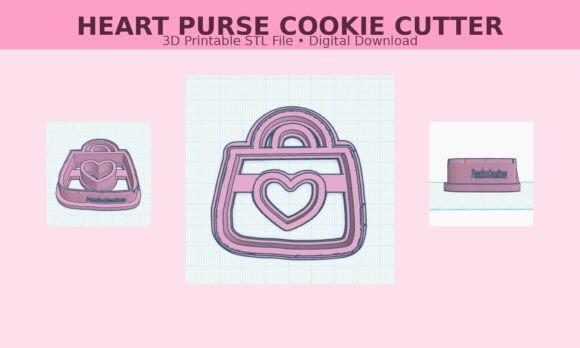
At its core, the Love Bag Cookie Cutter 3D Model for 3D Printing is an STL file intended for reproduction on FDM (Fused Deposition Modeling) printers. Unlike traditional cookie cutters that rely on extruded wire profiles, this design leverages the capabilities of additive manufacturing to create complex geometries. The defining characteristic of this model is its dual aesthetic: it mimics the silhouette of a handbag while integrating a heart detail, merging fashion motifs with romantic symbolism.
From a technical standpoint, the design prioritizes functionality alongside form. The geometry includes a sturdy handle wall and a clean cutting edge, which are critical for the physical act of pressing through dough. Many early 3D printed kitchen tools suffered from rough surfaces or weak structural integrity, but this specific model is optimized to minimize these issues. It is designed as a single-piece component, eliminating the need for assembly and reducing the risk of parts detaching during use. The default dimensions typically hover around 2.5 inches wide, offering a manageable size for most standard cookie sheets while remaining large enough to showcase intricate details.
Comparing Digital Models Against Traditional Cutters
When evaluating the Love Bag Cookie Cutter 3D Model for 3D Printing, it is necessary to compare it against the established alternatives found in retail stores. Traditional metal cutters offer superior durability and heat resistance, often lasting for decades. They provide a razor-sharp edge that slices through stiff dough with minimal effort. However, they lack customization. If a baker needs a specific size or a unique combination of shapes—like a purse with a heart—metal options are rarely available off-the-shelf without significant cost.
Plastic cutters, often sold in sets, are more affordable but can warp under pressure or lose their shape over time. They also suffer from the same limitation as metal: fixed designs. In contrast, the 3D printable model offers immediate scalability. Because the file is digital, the user can adjust the scale within their slicer software. Need a smaller version for mini-cupcakes? Or a larger statement piece for a cake topper? The flexibility is inherent to the format. Furthermore, the material choice, typically PLA (Polylactic Acid), allows for a matte finish that prevents dough from sticking as aggressively as some glossy plastics might.
However, there are tradeoffs. A 3D printed cutter requires an initial investment in hardware and filament. For a user who only intends to bake once a year, purchasing a pre-made cutter may be more economical. But for those who already own a printer, the marginal cost of printing the Love Bag design is negligible. Additionally, the edge sharpness of a 3D printed object depends heavily on the printer's calibration. While modern printers can achieve impressive precision, they generally cannot match the factory-ground sharpness of high-end steel cutters.
Structural Integrity and Material Considerations
A critical factor in the decision-making process is the material science involved. The recommended material for this model is PLA, a biodegradable thermoplastic derived from renewable resources. PLA is food-safe when printed correctly and does not release harmful fumes at low temperatures, making it suitable for kitchen environments. However, users must be aware that PLA is not dishwasher safe; exposure to high heat will cause warping. Hand washing is mandatory to maintain the cutter's longevity.
In comparison, stainless steel cutters can be tossed directly into a dishwasher, offering convenience that the 3D printed alternative lacks. Yet, the Love Bag Cookie Cutter 3D Model for 3D Printing compensates with design complexity. Achieving the "handbag" shape with a distinct heart indentation using injection molding or die-cutting would require expensive molds, driving up the unit price. 3D printing bypasses this barrier, allowing for complex internal structures and ergonomic handles that are difficult to manufacture traditionally.
Evaluating Print Settings and Optimization
To ensure the Love Bag Cookie Cutter 3D Model for 3D Printing performs effectively, specific print parameters must be followed. The design is optimized for a layer height of 0.2 mm, which balances print speed with surface smoothness. A lower infill percentage, typically between 15% and 20%, is sufficient because the primary requirement is rigidity rather than tensile strength. The orientation is crucial; printing flat on the build plate ensures the cutting edge remains perpendicular to the dough, preventing angled cuts that could distort the shape.
One of the advantages of this specific STL file is that it does not require support structures. This simplifies the workflow, reduces material waste, and eliminates the post-processing step of removing supports, which can sometimes leave rough marks on the cutting edge. Users should, however, pay attention to the first layer adhesion. A well-calibrated bed ensures the base of the handle and the bottom of the cutter remain level, which is vital for even pressure distribution when rolling the cutter through dough.
Ideal Use Cases and Limitations
The Love Bag Cookie Cutter 3D Model for 3D Printing is best suited for specific scenarios where customization and thematic relevance are paramount. It excels in event planning contexts such as bridal showers, bachelorette parties, or Valentine's Day gatherings where the visual theme of a "gift" or "love" is central. The ability to produce multiple copies quickly makes it ideal for large batches, provided the user has access to a printer or a local printing service.
Beyond cookies, the design's versatility extends to fondant work, clay modeling, and even soap crafting. The clean edges allow for precise shaping of soft materials, expanding its utility beyond just baking. However, it may not be the right choice for heavy-duty tasks involving very hard doughs or frozen mixtures, where the plastic might eventually crack under extreme stress. In such cases, a metal alternative remains superior.
Furthermore, the digital nature of the product means there is no physical inventory to manage. The instant download format allows for immediate access, but it requires the user to possess the technical literacy to slice and print the file. For those unfamiliar with 3D printing software, the learning curve might be a deterrent compared to simply buying a ready-to-use item.
Making an Informed Decision
Deciding whether to utilize the Love Bag Cookie Cutter 3D Model for 3D Printing ultimately depends on the user's existing resources and long-term goals. If you are a maker looking to expand your repertoire of custom tools, this model offers a compelling blend of aesthetics and function. It solves the problem of finding niche shapes that are unavailable in standard retail channels. The ability to customize the size and potentially modify the design further adds value for advanced users.
Conversely, if your priority is convenience and you lack access to 3D printing technology, a traditional cutter might be more practical. The time required to set up a print job, monitor the process, and post-process the part must be weighed against the simplicity of unboxing a store-bought item. However, for those willing to invest the time, the result is a personalized tool that can produce unique treats impossible to replicate with standard equipment.
In summary, the Love Bag Cookie Cutter 3D Model for 3D Printing represents a modern solution to a classic baking need. It bridges the gap between digital creativity and tangible results, offering a distinct advantage in customization and thematic design. By understanding its strengths in flexibility and its limitations regarding material durability, bakers can determine if this digital tool fits their specific workflow and event requirements.